

In Kathile Sub-county, Kaabong District (Karamoja), the Nangole-Chuwa Groundnut Production Group has transformed a persistent community challenge into a tangible pathway for growth. Located in Narengepak parish, Kathile sub-county, the group comprises 30 members (19 women and 11 men), formed in 2021 with the core aim of enhancing member welfare and boosting household incomes. For years, households in the parish grappled with recurring dry-season hardships, notably seasonal grass fires that decimated grazing lands and left livestock without adequate pasture. Families walked long distances in search of forage, wasting time, energy, and productive capacity. Rather than accepting these conditions as the norm, the group chose innovation and proactive problem-solving.
Initially, the members had limited exposure to formal trainings in both crop and livestock farming. The groups received capacity-building sessions focused on conflict management, early warning systems, climate-smart agriculture, and fodder production for livestock. The most recent exposure and practical training conducted in November 2025 was a hands-on fodder production workshop held at Narengepak Primary School.
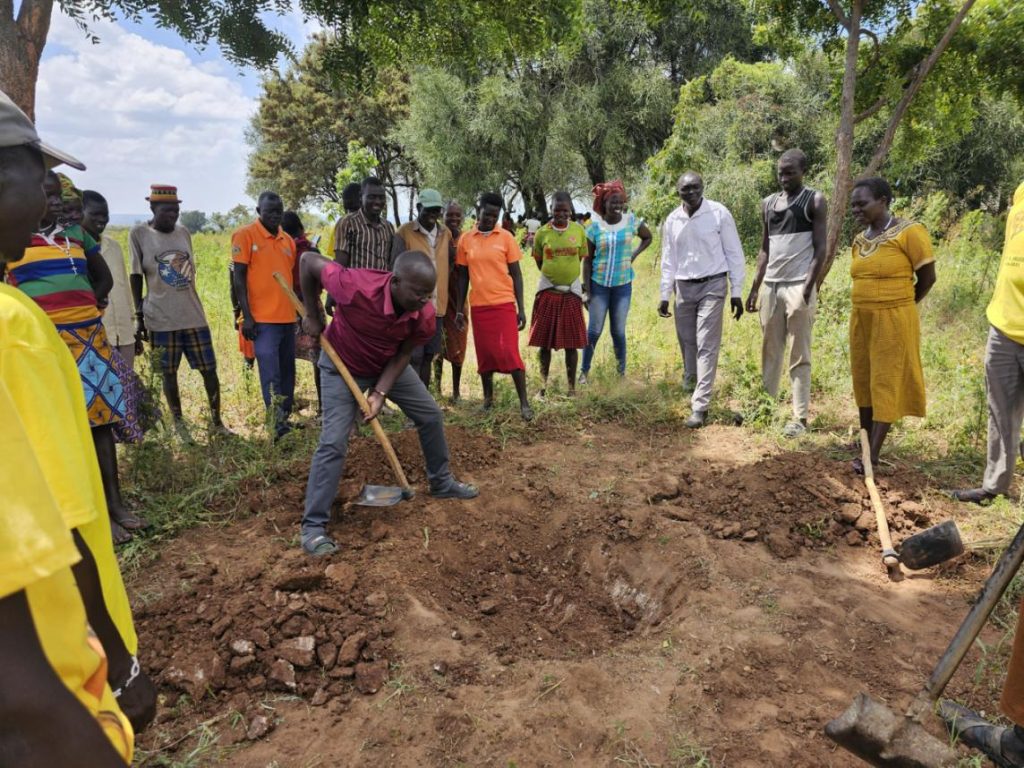
The Production Scientist from National Research Organization (NARO) Mr. Stephen Olinga demonstrating to the Livestsock farmer groups on how to make pit holes to be used in baling of hay during the training on Livestock fodder Production In Narengepak Primary school, Kathile subcounty,Kaabong District.
Armed with new skills, Nangole-Chuwa Groundnuts Production Group promptly identified fodder production as a strategic response to persistent dry-season challenges and increasingly frequent bush fires that depleted grazing fields and forced long treks for fodder. Within a month after the training, the group translated knowledge into tangible results: they began producing four bales of fodder per day, demonstrating a clear commitment to adopting innovative simple technologies. Looking ahead, the group has agreed to sustain fodder production at two days per week, yielding two bales per day over four weeks, or 16 bales per month. This steady output is designed to build reliable fodder reserves for the dry season and lay the groundwork for future commercial opportunities.
The group’s practical approach emphasizes accessible, low-cost methods. Members learned to harvest, chop, mix, bale, and store high-quality fodder using simple tools such as pangas, knives, slashers, basins, jerricans, jars, and empty sacks. They also relied on locally available inputs, including unspoiled grass, sorghum stalks, and selected tree shrubs. A modest salt-water mixture was incorporated to enhance nutritional value, transforming ordinary grass into a preserved, nutrient-rich feed for cattle.
Despite notable progress, the group continues to confront several challenges, such as grass scarcity due to ongoing bush burning, shortages of ropes and empty sacks for baling, and limited inputs for scaling production. To address these gaps, members have proposed improvising with locally available materials and pooling personal tools to support collective fodder production.
Today, the Group takes pride in storing multiple bales of nutritious fodder in preparation for the dry season. The group’s ambition is to further improve fodder quality and expand production capacity. In the long term, they envision supplying fodder to neighboring sub-counties and pursuing cross-border market opportunities. Anticipated benefits include increased household incomes, improved living standards, larger herds, and higher milk yields. What began as a modest training, delivered by the National Research Organization (NARO) under the auspices of the ADRA–STRENGTH project is growing into a broader dream: to supply fodder to nearby communities and potentially extend markets into Kenya.
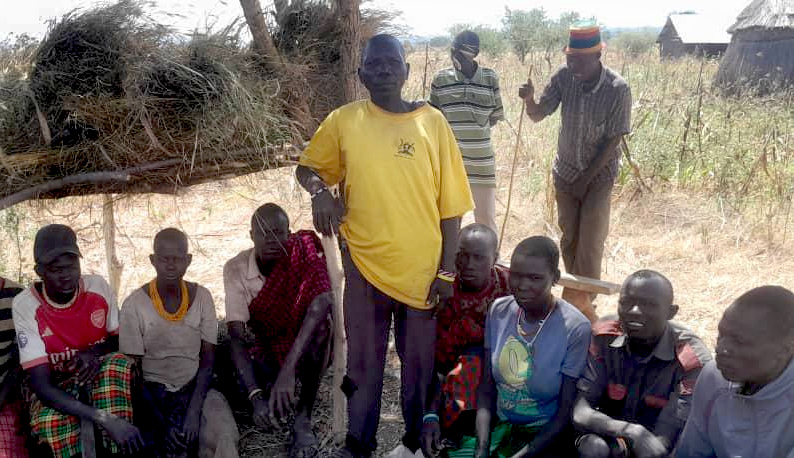
The group members of Nangole-Chuwa Groundnut production group posing for a photo with the Bales that they produced for their livestock. On the left is the chairperson of the group,Behind is a batch of the 4 bales that they made with the grass within the community.
The Nangole-Chwa Groundnut Production Group is emerging as a model of community-led innovation, resilience, and transformation in Kaabong District. Their experience demonstrates that knowledge, unity, and purposeful action can turn daunting challenges into stepping stones for sustainable progress. The group’s work embodies hope, economic opportunity, and a brighter future for both households and their livestock.
A concise summary
- Nangole-Chuwa Groundnut Production Group, formed in 2021 in Narengepak, Kathile Sub-county, Kaabong District, comprises 30 members (19 women, 11 men) with a focus on welfare and income through cooperation.
- Recurrent dry-season hardships, including grass fires that destroy grazing lands, threatened livestock and productivity.
- The ADRA-STRENGTH Project delivered training in conflict management, early warning, climate-smart agriculture, and fodder production, with a key November 2025 hands-on workshop by NARO.
- Post-training, the group began fodder production, achieving four bales per day within two weeks and planning to produce 16 bales per month (two days per week).
- They use affordable, locally available tools and inputs (grass, sorghum stalks, tree shrubs) and a salt-water mix to enhance nutritional value.
- Current challenges include grass scarcity, shortages of ropes and empty baling sacks, and limited inputs for scale; solutions involve improvisation and pooling resources.
- The group now stores fodder for the dry season, aims to expand to neighboring sub-counties and potentially cross-border markets (Kenya), with anticipated benefits of higher incomes, better living standards, larger herds, and increased milk yields.
- With ongoing support from ADRA, NARO, and partners, the group exemplifies community-led innovation, resilience, and transformation in Kaabong District.