
Nebbi District leaders have called for increased support to facilitate regular cross-border engagements with leaders and communities in the Democratic Republic of Congo (DRC), saying such cooperation is vital in preventing the spread of the Ebola Bundibugyo Virus and strengthening surveillance along the Uganda-DRC border.
The appeal was made during an orientation meeting of the Nebbi District Ebola Task Force on Tuesday, where leaders warned that Uganda’s efforts to contain the disease could be undermined if similar preventive measures are not implemented across the border.
Nebbi Resident District Commissioner (RDC) Robert Abak said Uganda and the DRC must coordinate their response to effectively contain the outbreak.
“We have to be on the same page with Congo if we are to win this war. It will not help if we ban disco parties and other mass gatherings here to contain the spread of Ebola while similar activities continue on the other side, attracting people to cross through porous borders,” Abak said.
According to the Ministry of Health, Uganda had registered 19 confirmed Ebola cases by Friday, including 14 imported cases and five local infections. Of these, 13 patients remained admitted, five had been discharged, and two deaths had been recorded.
As one of Uganda’s high-risk districts bordering the DRC, Nebbi remains vulnerable because of numerous ungazetted crossing points used daily by residents on both sides of the border.
Abak said longstanding social, cultural and economic ties between communities in Nebbi and eastern Congo continue to complicate disease control efforts.
“Many people in Nebbi have relatives in Congo. Some even own gardens across the border. Because of these family and economic ties, people regularly cross through ungazetted routes to visit relatives, cultivate land or conduct business,” he said. He added that smugglers and traders also use porous border points, increasing the risk of disease transmission.
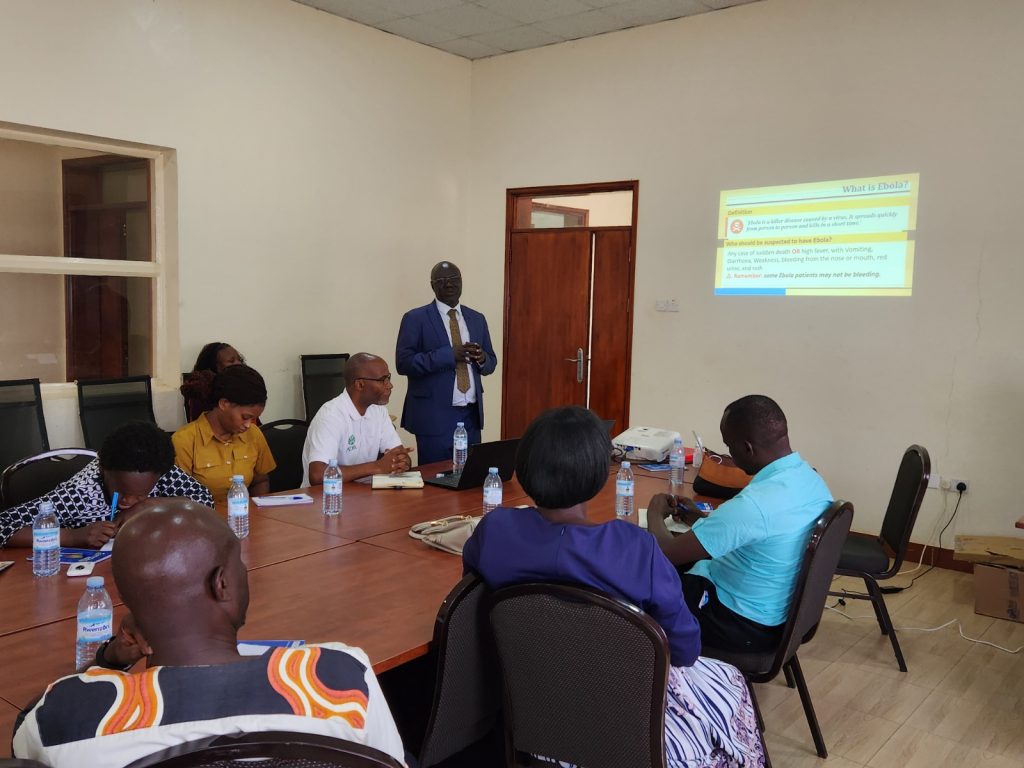
Assistant Commissioner for Health Promotion and Communication, Dr. Ronald Miria Ocaatre, training members of the Nebbi District Ebola Taskforce on Ebola prevention, surveillance, and response measures.
“Once leaders on the Congolese side are properly informed and engaged, they can help enforce preventive measures within their communities. That is why these meetings are so important,” he added.
Abak revealed that district authorities had received intelligence reports indicating that a group of people had reportedly escaped from an Ebola treatment centre in Congo and could be heading toward Uganda.
“We have to remain on high alert. Our teams are moving to border communities to share information and encourage residents to report any unfamiliar persons arriving in their villages,” he said.
He also disclosed that district authorities recently stopped plans to transport the body of a deceased person from Congo into Uganda for burial.
The deceased reportedly belonged to a family with relatives on both sides of the border.
“We engaged the family and local authorities and agreed that the burial should take place in Congo. We also advised relatives from Uganda not to attend the funeral because such gatherings pose a significant risk of spreading the virus,” he explained.
Gatherings restricted
As part of Ebola containment measures, Nebbi District has suspended cattle markets and restricted large public gatherings that attract traders and visitors from across the border.
Abak said authorities recently closed Nyalip Market in Akworo sub-county because of its proximity to the border. However, operators reportedly relocated the market about 500 metres into Congolese territory, where it continues to attract large crowds.
“Many Ugandans continue crossing into Congo to buy and sell goods there. Unless leaders on both sides coordinate their actions, it becomes difficult to effectively enforce public health measures,” he said.
Daily local markets within Uganda will continue operating under strict observance of standard operating procedures (SOPs), which district authorities say are easier to monitor.
However, enforcement remains challenging because of limited personnel and logistical constraints.
“We have only a few teams covering five sub-counties. Some residents initially resisted preventive measures because they believed Ebola was only in Congo and not Uganda. In some cases, we have had to deploy security personnel to ensure compliance,” Abak said.
While churches remain open under strict health guidelines, discos and other mass entertainment events have been suspended.
Resource shortages threaten preparedness
District officials also expressed concern over limited resources for Ebola preparedness and response.
“Logistical support remains a major challenge because the border area is vast. We still lack essential supplies such as sanitizers, gloves, aprons and equipment for isolation centres,” Abak said.
He noted that although health workers are mentally prepared to respond to Ebola cases, shortages of protective equipment could expose them to unnecessary risks.
The district recently received 1,000 litres of fuel from the Uganda People’s Defence Forces (UPDF), but officials said it was exhausted within three days due to intensive border patrols, surveillance activities and community sensitisation campaigns.
According to the District Health Office, several Ebola alerts have been investigated since the outbreak was announced on May 15, but all samples collected so far have tested negative.
Why Congolese nationals are crossing into Uganda
Ronald Ocaatre, Assistant Commissioner for Health Promotion and Strategic Health Communication at the Ministry of Health, said increasing undocumented movement of Congolese nationals into Uganda remains a major concern.
He attributed the trend to strong family ties, shared languages and cultural connections among border communities.
However, he said another key factor is the confidence many Congolese have in Uganda’s healthcare system.
“The information we have received from Congo is that many people believe their chances of surviving Ebola are higher if they are treated in Uganda. They have confidence in Uganda’s health systems and response mechanisms,” Ocaatre said.
He added that many Congolese also perceive Uganda’s disease control measures as more effective.
“They believe the chances of contracting Ebola are lower in Uganda because of the strict control measures that are in place. This explains why some people are crossing the border seeking safety,” he said.
Ocaatre emphasized that Uganda is not stopping legitimate cross-border movement but urged travellers to use gazetted border points where screening can be conducted.
“We are encouraging people to use official entry points so they can be screened. Those who are suspected of being infected can then be isolated and managed appropriately,” he said.
Ocaatre revealed that a recent delegation from Kinshasa visited Uganda and discussions focused on strengthening collaboration between the two countries.
He said both governments agreed on the need to establish and strengthen quarantine facilities on the Congolese side, while Uganda committed to supporting response efforts with technical expertise and health personnel.
The Assistant Commissioner stressed that regular cross-border meetings remain among the most effective strategies for containing the outbreak.
“The idea is to fight this disease together, share information, compare notes and agree on common approaches. Ebola does not recognise national boundaries,” he said.
He also cautioned against stigmatising Congolese nationals.
“We should not assume that every person coming from Congo has Ebola. Stigmatisation only makes disease control more difficult,” he said.
Ocaatre further urged leaders to leverage traditional and cultural institutions, particularly the Alur Kingdom, whose influence extends across the Uganda-DRC border, to promote public health messages and encourage compliance with preventive measures.
Partners support response efforts
John Mwanza, ADRA Uganda’s Country Director, said the organisation is supporting Ebola preparedness and response efforts in the high-risk West Nile districts of Zombo, Nebbi, Pakwach and Arua, key entry points for travellers from the Democratic Republic of Congo (DRC).
“Working with the Ministry of Health, District Task Forces and community leaders, we are promoting Ebola awareness, hygiene, early reporting and disease prevention. We are also training District Task Forces, supporting public handwashing facilities and reaching communities through radio programmes and volunteers. ADRA’s interventions are expected to benefit about 90,000 people, particularly vulnerable groups, while helping curb misinformation and strengthen surveillance,” he said
Henry Samanya, Ebola Response Coordinator at ADRA-Uganda noted that frequent cross-border movement for family visits, trade, education and healthcare increases the risk of disease transmission, especially through ungazetted crossing points.
He said they have begun training district teams and distributing Ministry of Health-approved information materials, including posters, surveillance registers and referral forms for schools.
“We have identified several priority needs, including support for logistics, training of health workers and village health teams, and facilitation of cross-border engagements. These meetings will help ensure leaders on both sides agree on common measures for controlling the virus,” Samanya said.
Nebbi District Chairperson George Othuba welcomed the support, saying Ebola prevention requires a sustained collective effort.
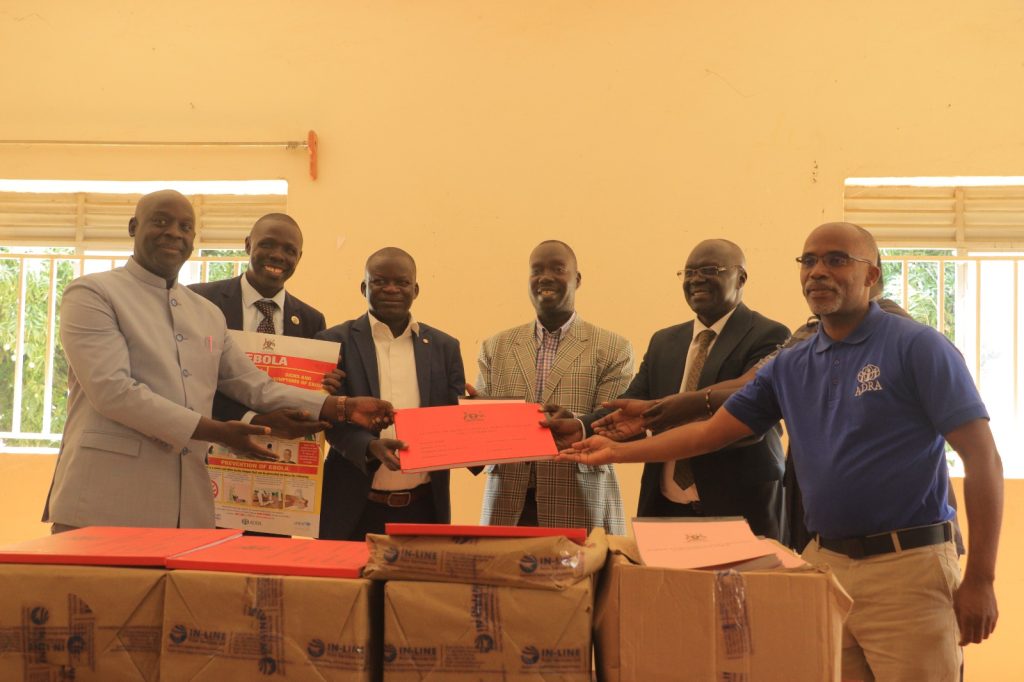
The ADRA-Uganda Ebola Response Coordinator Henry Samanya handing over survilleance regustration books to Arua district Ebola taskforce.